Standing instructions are the missing control layer in digital asset accounting.
Most reporting workflows can show what happened: a transaction occurred, a lot was selected, a transfer was treated a certain way, a value was overridden, and a report was generated.
For finance, tax, treasury, and audit teams, that only answers part of the question. The harder review comes when someone needs to understand why the system treated the activity that way, whether the treatment came from a standing policy or a one-time instruction, whether the same rule was applied consistently across similar activity, and whether the explanation existed at the time or had to be reconstructed later from memory and workpapers.
The transaction history matters, but it is not enough by itself. A financial record should also remember the decision history that shaped the reported result.
A Correct Report Is Not The Same As A Complete Record
A report can be correct and still be incomplete.
That becomes clear during review. The gain/loss number may tie, the wallet balances may reconcile, the lot detail may appear reasonable, and the final workbook may be clean enough to circulate. Then someone asks how the treatment was determined.
If the answer lives in a spreadsheet note, an advisor email, an internal Slack thread, or a one-off explanation from the person who prepared the file, the organization does not have a durable control layer. It has a result with a fragile memory around it.
That fragility becomes more expensive as digital asset activity becomes more institutional. Treasury teams need default lot-selection rules for ordinary dispositions, advisors need transaction-specific overrides for planned sales or donations, controllers need assurance that closed-period rules were applied consistently, and auditors need to know whether the reported outcome followed from a policy that existed before the review began.
A correct output is only defensible if the organization can also show the instruction, policy, or override that produced it.
Standing Instructions Make Judgment Repeatable
Digital asset accounting is full of moments where judgment, policy, and operational reality meet.
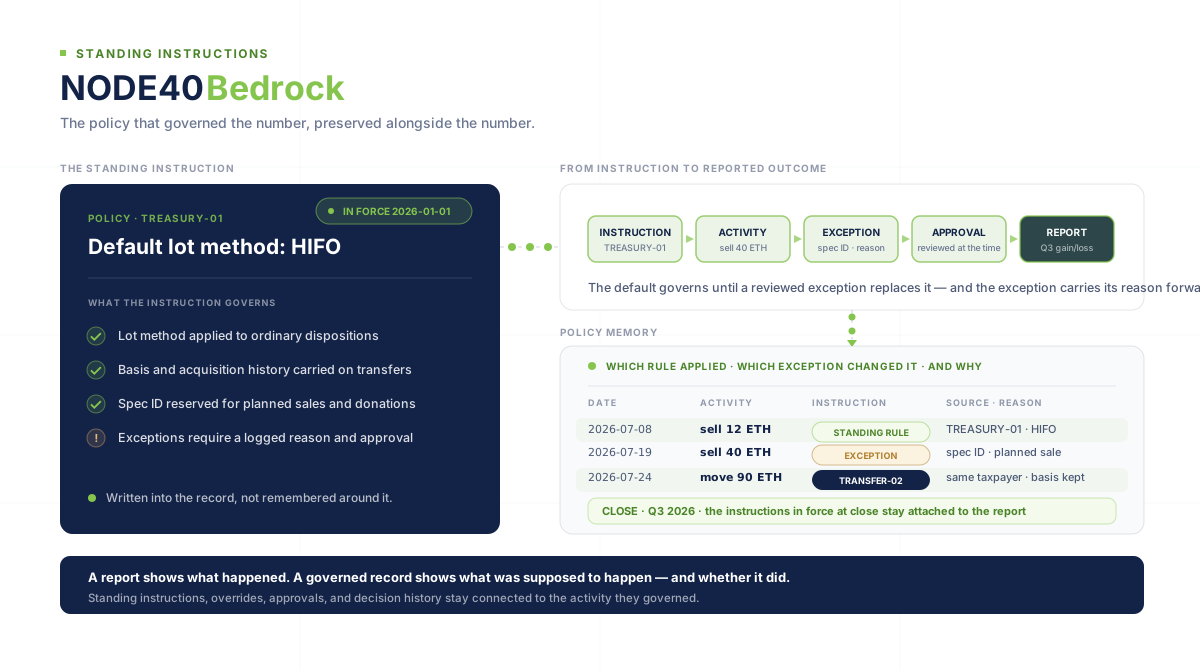
A team may use one lot method as the default for ordinary dispositions, preserve basis and acquisition history across internal transfers, reserve specific identification for planned sales or other transactions where the lot decision matters, and document reviewed exceptions with the reason they were approved at the time.
Those decisions are part of the financial logic of the record. Standing instructions make that logic repeatable by giving the system a way to apply policy consistently, preserve the reason a treatment was used, and maintain a reviewable path from instruction to reported outcome.
Without that layer, teams often reconstruct intent after the fact: they look at the final report, infer what must have happened, check old files, ask the advisor, and hope the preparer remembers why one transaction was handled differently from another.
That may work once. It does not scale into a governed reporting process.
Bedrock Was Built Around The Instruction Layer
Bedrock treats standing instructions as part of the financial record, not as informal knowledge sitting outside the system.
That distinction matters. Lot-selection rules should not exist only as remembered preferences, transfer treatment should not depend on someone recalling that a wallet movement represented a same-taxpayer transfer, and overrides should not become changed numbers with the reason, timing, and context stripped away.
In Bedrock, instructions, rules, overrides, approvals, lots, transfers, close events, and reports are meant to remain connected. The system is designed so the organization can see not only what the record says, but what governed the record when the decision was made.
Professional judgment still matters. Bedrock does not guarantee that every decision is right, and it does not turn weak source data into strong evidence. Its value is more practical: it gives teams a controlled place to preserve the decision logic they already rely on.
When the question comes later, the answer should not depend on archaeology.
Policy Memory Matters More As Activity Gets More Complex
Standing instructions become more important as digital asset operations move beyond simple buy, hold, and sell activity.
In one Bedrock scoping discussion, the accounting problem was not whether the system could see a disposition on-chain. The issue was whether the company could apply its standing lot-selection policy by default, override that policy when a specific transaction required different treatment, and preserve enough contemporaneous support for an advisor or auditor to understand the decision later.
That is the gap the chain cannot close. It can show movement, but it cannot tell the organization which accounting instruction was supposed to govern that movement.
A governed digital asset record should preserve the connection between activity and instruction: which standing rule applied, which exception changed the treatment, which instructions shaped the numbers at close, and which approvals supported the reported outcome.
That kind of record does not make every future question disappear. It does something more useful: it lets the organization answer from the record instead of rebuilding the story from scattered evidence.
Where Bedrock Is Different
Many tools can calculate from transaction data, reconcile balances, or export reports.
Bedrock is built around a deeper requirement: digital asset reporting needs an operating record that preserves the policies, instructions, decisions, and evidence behind the numbers.
That is what makes standing instructions important. They are part of the control environment around the financial record, not administrative settings buried somewhere outside the review trail.
For teams managing digital assets at institutional scale, the question is whether the organization can explain how the result was produced, which instruction governed the treatment, and why the record can still be trusted when a reviewer asks six months later.
That is the difference between a report and a governed record.
If your team is managing digital asset activity that needs to survive finance, tax, advisor, board, or audit review, this is worth seeing in practice.
Schedule time with NODE40 to see how Bedrock handles standing instructions.