Digital asset reporting has a credibility problem.
Producing a number is no longer enough. Finance, tax, audit, and board-level stakeholders increasingly need to know how that number was produced, what assumptions shaped it, and whether the same answer can be reproduced from the same underlying record.
Where did the basis come from? Which lot satisfied the disposal? Did an internal transfer preserve the original acquisition date and cost basis? Was a shortfall resolved with evidence, or hidden behind a balancing entry? Who changed a value, when did they change it, and why?
These are not edge cases. They are the operating questions behind digital asset treasury.
That is why we built NODE40 Bedrock.
Bedrock is a governed digital asset treasury accounting system for lot-level tax decisions, GAAP support, transfer evidence, reporting, and audit-ready controls. It turns treasury accounting into an explainable system of record, not a black-box calculation. Every lot, transfer, override, closed period, and reporting output carries the reasoning behind it.
In practical terms, Bedrock is two products in one: a tax decision system and a GAAP accounting support system backed by the exact same transaction history. The tax view and the accounting view should not be reconstructed from separate files, separate assumptions, or separate versions of truth. They should come from the same governed record.
The goal is not another dashboard for crypto activity. The goal is a financial record that can stand up to review.
The default is a decision
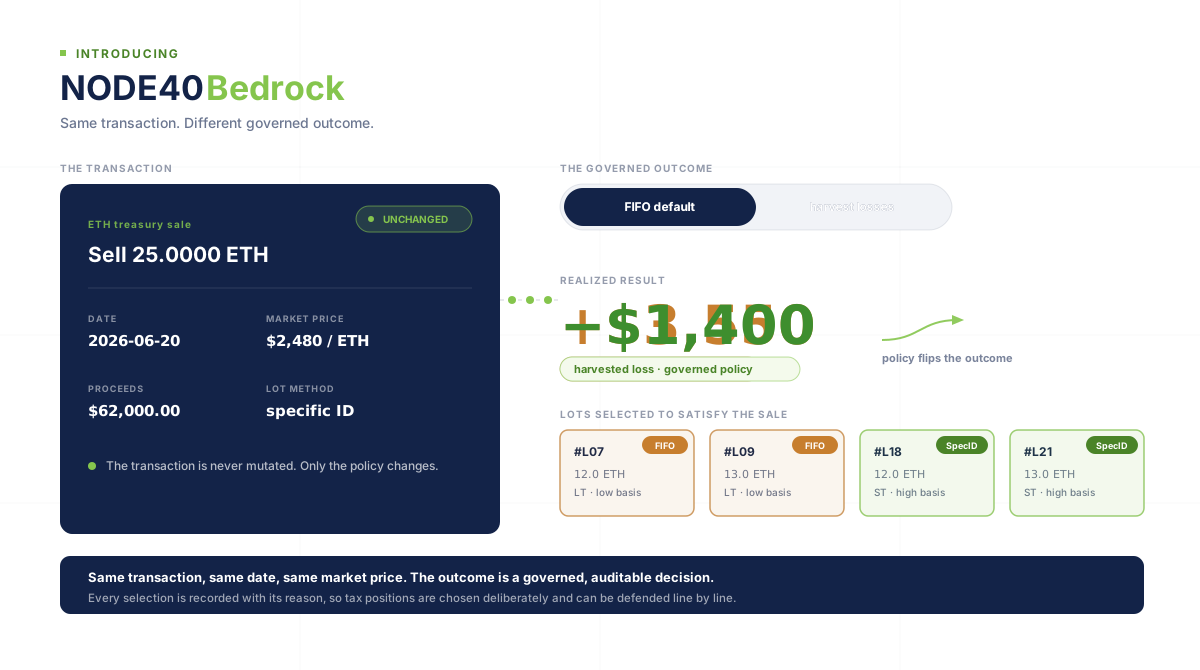
Many treasury and tax workflows still treat lot selection as a background setting. FIFO, or some similar default, is selected once and then applied across future disposals. The finance team may never see the materially different outcome sitting next to that default.
That default is itself a tax and accounting decision. It is just often made by the software instead of by the team that has to defend the result.
Bedrock starts from a different premise: lot selection should be governed policy. FIFO can exist as a fallback, but it should not be the whole strategy. Treasury and tax teams need a way to define which lots are available, which lots are protected, which rules apply, and why a specific disposal was satisfied the way it was.
That matters because the same transaction can produce a very different tax outcome depending on the lots selected. Same transaction, same date, same market price, different governed outcome.
The resulting tax and accounting treatment is not just a calculation. It is the result of policy, evidence, and control.
The record has to preserve the story
Digital asset treasury records break when they lose continuity.
An internal transfer should not reset the tax history of an asset. A missing deposit should not disappear into a balancing entry. A value override should not become an unexplained number in a close workbook. A closed period should not quietly change after the fact.
Bedrock is designed to preserve the story behind the record.
When assets move between wallets, Bedrock ties transfer matches to visible evidence. When lots move, they carry basis and acquisition date forward. When computed values appear, the system can show the math behind them. When a team makes a manual change, the reason is captured at the point of change, not reconstructed later from memory.
The details matter because review pressure exposes weak records quickly. A number that cannot be traced is not a defensible number. A report that cannot explain its assumptions is only partially useful.
Governance cannot be bolted on at the end
Audit readiness is not something a team adds after the reporting period closes. It has to be part of how the record is created and changed.
Bedrock records the who, when, and why behind material changes. Value overrides require reasons. Manual entries are permanently badged as manually entered. Lot reassignments and rule applications are attributed. Feed corrections show their expected impact before they run.
Shortfalls are surfaced instead of hidden. If holdings do not reconcile, Bedrock does not quietly fabricate a clean result. The open issue appears as something the team has to resolve. If a synthetic placeholder is used, it remains visibly synthetic. If the real missing deposit is entered, the actual basis is preserved.
Closed periods are real boundaries. Once a period is closed, later changes cannot silently bleed backward into reported numbers. The close creates a fixed point the organization can stand on.
The audit trail is append-only. Records can be written and read, never updated or deleted.
This architecture matters because the review question is rarely "can you export a report?" The real question is "can you explain what changed, who approved it, and why the reported number is still reliable?"
One record for finance, tax, and audit
Digital asset operations often fragment across tools and files. One system has exchange activity. Another has wallet history. Another has tax-lot assumptions. Another has the close workbook. Another has the audit response. Each stakeholder maintains a version of the truth.
Bedrock is designed to reduce that fragmentation.
Finance can work from GAAP-supporting ledgers, reconciled balances, and close context. Tax can review lot-level decisions, holding periods, and specific identification support. Audit can trace outputs back to source activity, overrides, approvals, shortfalls, feed corrections, and period close context.
Reports come from the same governed record: gain/loss views, GAAP-oriented accounting outputs, reconciliation reports, token reports, PDF financial reports, and Excel workbooks with lot-level cost basis and proceeds detail. When the record balances, the system can show why. When data is missing, the gap stays visible instead of being absorbed into the math.
That is the operating model digital asset treasury teams need as digital assets become more material to financial reporting.
The standard is explainability
Digital asset treasury is moving into a more institutional phase. Finance teams need more than balances. Tax advisors need more than year-end exports. Auditors need more than screenshots. Boards need more than confidence language.
They need a record that can explain itself.
That is the standard Bedrock is built around.
Every number should be traceable to source activity. Every lot decision should be governed by policy or documented specific identification. Every transfer should preserve the history of the asset. Every override should carry a reason. Every shortfall should remain visible until resolved. Every closed period should stay closed.
When a board member, auditor, tax advisor, or internal stakeholder asks how a number was produced, the answer should already be in the record.
That is Bedrock.
This post opens a series on the parts of Bedrock that matter most for digital asset treasury teams: lot intelligence, transfer evidence, audit governance, treasury workflows, written options, and reporting from a single governed record.
If your team is responsible for digital asset treasury accounting, the central question is not whether you can produce reports. It is whether the record behind those reports can explain itself.
Talk to NODE40 about governed digital asset treasury accounting.