At NODE40, we regularly encounter reporting problems when customers come to us from other platforms. These are not just theoretical concerns. They are issues we have to investigate and resolve to produce records those customers and their accountants can rely on.
That work has taught us what clean, defensible, auditable records require: reconciled asset movements, traceable cost basis and transaction treatments that can be explained. A finished tax report is not a substitute for that underlying evidence.
If you signed a return using another provider's crypto calculations, can you trace the reported gains back to the transactions?
For accountants, that question belongs in the review process. For individuals who have already filed, it is a reason to look beyond the final gain or loss figure.
The issue is not whether you used software. It is whether the report gives you enough evidence to explain the numbers you relied on.
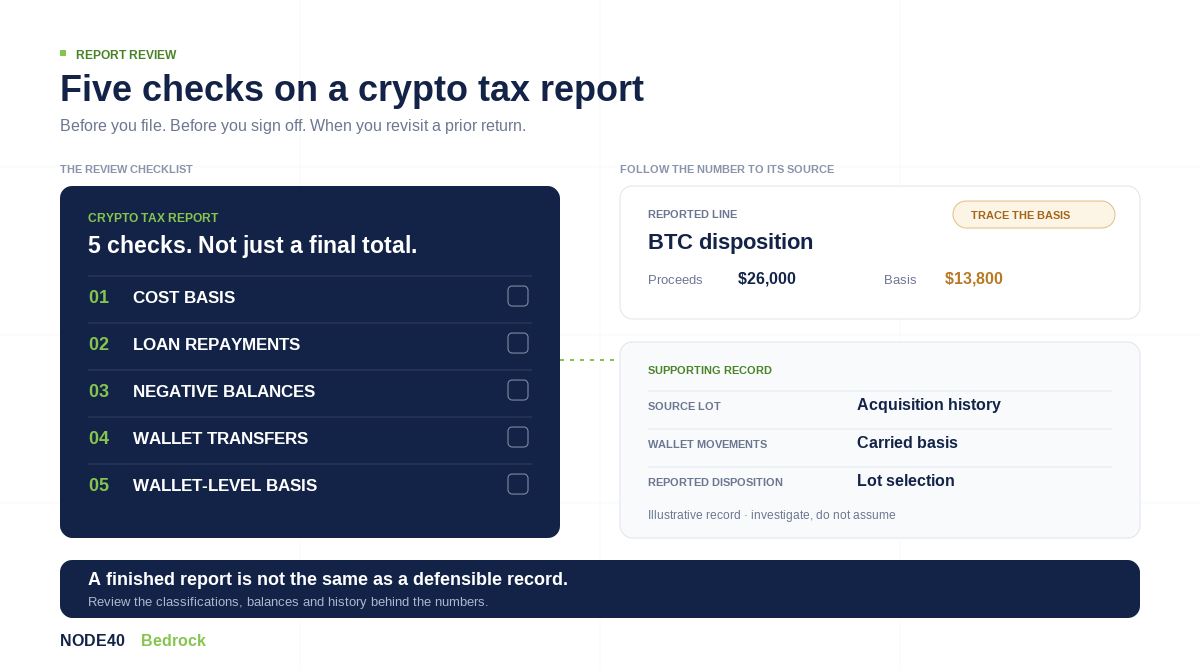
These five checks can help identify where a report deserves a closer look. A warning sign is not proof of an incorrect return. It is a reason to ask for the records and reasoning behind it.
1. Trace unusually large losses on small transactions
Sort the report by cost basis and loss. Look for small network fees or low-value disposals carrying unusually large amounts of basis.
A large loss is not automatically wrong: an asset's current value may be far below its acquisition cost. The question is whether the basis belongs to the quantity actually disposed of.
Ask the provider: Which acquisition lots supplied these units, and how much basis was assigned to the units used?
Check the quantity, acquisition cost and remaining lot balance together. Do not accept a total without the calculation behind it. IRS guidance treats digital assets used to pay transaction fees as dispositions that can produce gain or loss.[1]
2. Separate loan repayments from collateral movements
Find transactions involving lending protocols. Review repayments, interest, collateral releases and liquidations separately rather than accepting one label for the entire interaction.
If every repayment shows zero gain or loss, ask how that result was reached. Zero may be explainable; a label alone is not an explanation.
Ask the provider: What assets left the wallet, which lots supplied them, and what treatment was applied to each part of the transaction?
This check is about exposing assumptions, not prescribing one tax treatment for every lending arrangement. Have the tax professional reviewing the return evaluate the treatment against the actual arrangement and transaction records.
3. Investigate negative balances
Find the first point at which a running asset balance falls below zero. Work backward from that transaction.
Check for missing acquisition history, unmatched transfers, duplicated disposals and transaction-ordering issues. Then inspect how the report handled basis for the affected disposals.
Ask the provider: What explains the negative balance, and which reported gains or losses depend on its resolution?
Do not assume the software guessed the basis. Do not assume the resulting numbers are reliable either. Ask for a reconciliation that explains both the units and the basis.
4. Check transfers between your own wallets
A transfer between wallets or accounts belonging to the same taxpayer generally does not itself create a taxable event. Crypto used to pay transaction fees requires separate consideration.[1]
Find a transfer in the sending wallet and follow it into the receiving wallet. Check that the transferred units retain their basis and acquisition history, rather than appearing as a sale followed by an unrelated acquisition.
Ask the provider: Can you show the outgoing and incoming records together, including the basis carried between them?
Be precise about ownership. A wallet you control is not necessarily owned by the same taxpayer as another wallet you control.
5. Confirm wallet-by-wallet or account-by-account basis
For 2025 and later activity, inspect how the report identifies the units sold from each wallet or account. A consolidated report is not itself a problem. The underlying lot selection is what matters.[1]
Ask the provider: Can you show that the units assigned to this disposal were held in the wallet or account from which it occurred?
Also ask how pre-2025 unused basis was allocated during the transition. Rev. Proc. 2024-28 provides a transition safe harbor. Separate relief under Notice 2025-7, extended by Notice 2026-20 through December 31, 2026, addresses identification of broker-held units; it is not blanket permission to pool basis across wallets.[2]
If you prepared or signed the return
Using another provider's report does not eliminate the need for professional judgment.
Circular 230 §10.34(d) permits good-faith reliance on client information without verification, but requires reasonable inquiries when that information appears incorrect, inconsistent or incomplete. Section 10.21 addresses a practitioner's obligation to advise a client promptly after learning of an error or omission in a previously submitted return, including its consequences.[3]
Preparer penalties can also apply to understatements involving unreasonable positions or willful or reckless conduct. A reporting discrepancy does not automatically establish either condition.[4]
The practical question is this: if one of these checks raises a concern, what evidence supports the position on the return?
Document the question, obtain the supporting records and evaluate the explanation. A comparison can help identify differences worth investigating. It does not replace your judgment or determine whether an amendment is required.
If you already filed your own return
An unexplained number is worth investigating even after filing.
An error could mean you underpaid tax or paid more than you should have. Certain underpayments can attract a 20% accuracy-related penalty. The penalty is not automatic for every mistake; reasonable-cause and good-faith relief may apply, depending on the facts.[5]
Keep the original report and underlying records. If the review identifies a potential error, discuss it promptly with a qualified tax professional. Do not amend solely because two software reports disagree. First establish what caused the difference and which treatment the facts support.
Request a free NODE40 report comparison
Already filed using another provider? Signed a client's return based on its results? Start with a comparison of the numbers you relied on.
For eligible holders of $1 million or more in digital assets, and the accountants advising them, NODE40 proposes a no-cost comparison of an existing report with NODE40 Bedrock outputs for an agreed scope of activity.
We will first confirm supported activity, the reporting period and the records needed. The proposed deliverable is a side-by-side comparison highlighting identified differences within that scope, with transaction-level detail where the available records support it.
Matching totals do not certify a return. Different totals do not establish which report is right. The value is having specific differences and supporting records to investigate, rather than relying on the final number alone.
Tell us whether you are reviewing your own report or a client's. Do not submit tax documents with the initial request; secure intake and any required client authorization will be arranged after scope is confirmed.
This article provides general information about U.S. federal tax reporting as of November 2026. It is not legal, tax or accounting advice and does not create a professional relationship. NODE40 provides software, not a tax opinion or assurance that a return is correct. Consult a qualified professional about your circumstances, including any decision to amend a return.
Sources
[1] IRS, Frequently asked questions on digital asset transactions. Relevant topics: dispositions for transaction services, same-owner transfers, identification of units and wallet/account basis. https://www.irs.gov/individuals/international-taxpayers/frequently-asked-questions-on-digital-asset-transactions
[2] IRS, Notice 2026-20, including its discussion of Rev. Proc. 2024-28 and extension of Notice 2025-7 relief. https://www.irs.gov/pub/irs-drop/n-26-20.pdf
[3] Treasury Department Circular 230, §§10.21 and 10.34(d). https://www.irs.gov/pub/irs-pdf/pcir230.pdf
[4] IRS, Tax preparer penalties, including IRC §6694. https://www.irs.gov/payments/tax-preparer-penalties
[5] IRS, Accuracy-related penalty. https://www.irs.gov/payments/accuracy-related-penalty