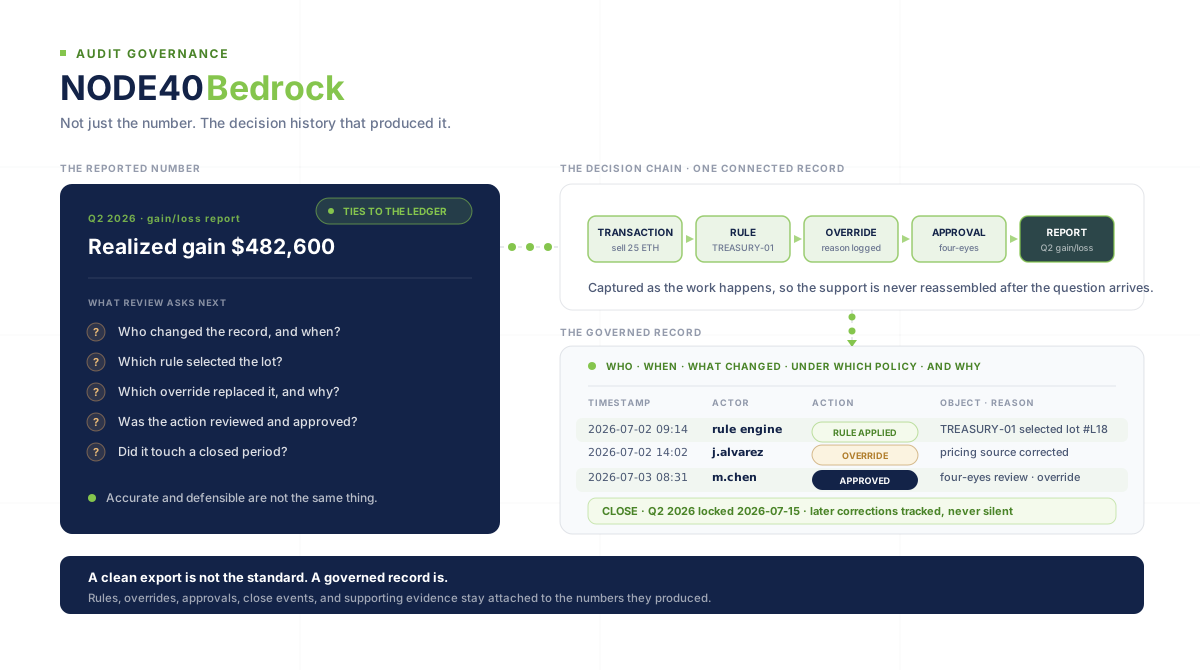
Digital asset audit governance belongs inside the financial record. A report can be accurate and still be hard to defend. The number may tie, the balance may reconcile, and the report may export cleanly, but when an auditor, advisor, controller, board member, or tax reviewer asks how the result was produced, the organization needs more than the final output. It needs the decision history that explains the output.
The strain usually appears after the team has already done the work. A lot has been reassigned, an override has been entered, a period has been closed, or a support file has been attached. The decision happened, but the explanation lives outside the financial record, scattered across workpapers, inboxes, screenshots, message threads, and memory.
Review should not depend on that kind of reconstruction. The decision, the reason, the timing, the approval context, and the evidence should already be part of the record that produced the number.
The Wrong Standard Is A Clean Export
Most reporting workflows are built around the final artifact: the gain/loss report, the roll-forward, the reconciliation package, the advisor workbook, or the PDF that gets dropped into a review folder. Those outputs matter, but they are not the whole standard.
The weakness shows up when a reviewer asks what happened before the export existed. A report can show a realized gain number without preserving the rule that selected the lot. A workbook can show an adjusted value without keeping the reason for the override attached to the change. A close package can show a reconciled position while leaving the team to prove later that subsequent changes were blocked, approved, or traced.
That gap creates expensive review work. Someone has to reconstruct the story after the fact by finding the note, matching the file, explaining the exception, proving the timing, and showing that the final number still follows from the underlying record.
A clean export is useful, but the stronger standard is a governed record.
Audit Readiness Starts Before The Audit
Audit governance is often treated like something that happens at the end of the process. The reporting period closes, the files are gathered, the questions arrive, and the team assembles support.
That model is fragile for digital assets because the record changes through many small decisions before the review ever begins. A lot may be selected under a standing rule, then later overridden for a specific transaction. A transfer may preserve basis because the facts support same-taxpayer treatment. A value may be adjusted because the original source data was incomplete. A period may close while an exception remains visible for later resolution.
These are not just operational details. Each one can shape the number someone later relies on.
Bedrock starts from a different premise. The decision record should be created as part of the financial workflow, not recreated during review. When a rule applies, its effect should be preserved. When a reviewer overrides the rule, the reason should travel with the change. When a lot is locked, assigned, transferred, encumbered, or consumed, that event should remain connected to the reported outcome it affects.
That does not eliminate professional judgment, and it does not turn weak support into strong evidence after the fact. The value is more practical: Bedrock gives the organization a controlled place to preserve what it knew, what it decided, and how that decision affected the record at the time it mattered.
That continuity is what makes the record useful under pressure.
Governance Is More Than Permissions
Access control matters, but governance is not just deciding who can click a button.
For finance, tax, and audit teams, the deeper question is whether the system preserves the context around decisions that change the record. A controlled workflow should show that a user had permission, but it should also preserve what changed, the reason recorded at the time, the policy or rule that applied, and the path from that action into reporting.
A reasonable concern is that governance can become overhead. That is true when controls sit outside the workflow and force teams to document the same decision twice. The better model is to capture the context as the work happens, so reviewability is a byproduct of the operating record rather than a separate project at the end.
Digital asset reporting often breaks at the handoff between those pieces. Transaction data may live in one system, the lot decision in another, the approval in a message thread, the support file in a folder, and the final report in a separate export workflow. Each piece may be true, but the record is weak because the pieces are disconnected.
Bedrock is designed to keep those pieces together. Transactions, lots, rules, overrides, approvals, close events, and reporting outputs should trace through the same governed record so important actions are visible, attributable, and reviewable without rebuilding the operating history by hand.
Closed Periods Need Real Boundaries
One of the clearest tests of a governed financial record is what happens after a period closes.
If later edits can silently change prior numbers, the organization does not have a reliable close. It has a moving target. That creates risk for finance teams, tax advisors, and auditors because the support package may no longer reflect the same record that produced the original report.
Bedrock treats close context as part of the control model so a closed period becomes a fixed point the team can stand on, while the history of later activity and corrections remains visible. Material changes should be traceable, unresolved issues should not disappear into balancing entries, and support should stay connected to the decision it supports.
That is the kind of record that can support review confidence.
Where Bedrock Is Different
Many tools can produce digital asset reports. Bedrock is built around the harder problem of preserving the governance history behind those reports in a way that remains useful across finance, tax, treasury, accounting, and audit workflows.
It is not just producing outputs from digital asset activity. It is helping preserve the evidence, decisions, controls, and review context that make those outputs defensible.
The practical value is simple: when the question comes, the answer should not depend on whoever remembers the spreadsheet. It should be available from the record.
If your team is managing digital asset activity that needs to survive finance, tax, advisor, board, or audit review, this is worth seeing in practice.
Schedule time with NODE40 to see how Bedrock handles audit governance.